11 Signs Your Career Growth Has Stopped (And How to Restart It Fast)
This post may contain affiliate links. At no extra cost to you, I may earn a small commission if you make a purchase. Read full disclosure »
Introduction: Why Your Career Growth Has Stopped (And Why Ignoring It Is Risky)?
You’re putting in the effort.
You meet deadlines. You handle responsibilities. You show up every day and do what’s expected.
But despite all that… nothing is changing.
No promotions.
No meaningful salary growth.
No new opportunities.
And slowly, a frustrating thought starts creeping in:
“Has my career growth stopped?”
If you’re asking that question, you’re not alone. Many professionals hit a phase where progress slows down—or completely stalls—without any clear warning.
What makes this situation dangerous is not just the lack of growth. It’s how easy it is to normalize stagnation.
You tell yourself:
- “Maybe next year will be better.”
- “At least I have job security.”
- “This is just a phase.”
But months turn into years.
And before you realize it, you’re not just stuck—you’re falling behind in a competitive job market.
If this feels familiar, there’s a high chance you’re already experiencing deeper signs of stagnation. In fact, many professionals first notice emotional signals before practical ones. If that resonates, you should read the guide on feeling stuck in your career.
What Does It Really Mean When Your Career Growth Has Stopped?
Career stagnation isn’t always obvious.
It’s not just about staying in the same job title. It’s about a lack of progress in skills, opportunities, income, and direction.
Here’s the reality most people overlook:
You can be busy… and still not be growing.
You can be productive… and still be replaceable.
You can be loyal… and still be overlooked.
When your career growth has stopped, it usually shows up in subtle ways:
- You’re doing the same type of work repeatedly
- Your responsibilities haven’t evolved
- Your learning curve has flattened
- Your visibility in the organization hasn’t improved
And perhaps most importantly—you don’t have a clear sense of where your career is heading.
That lack of direction is often the root of long-term stagnation.
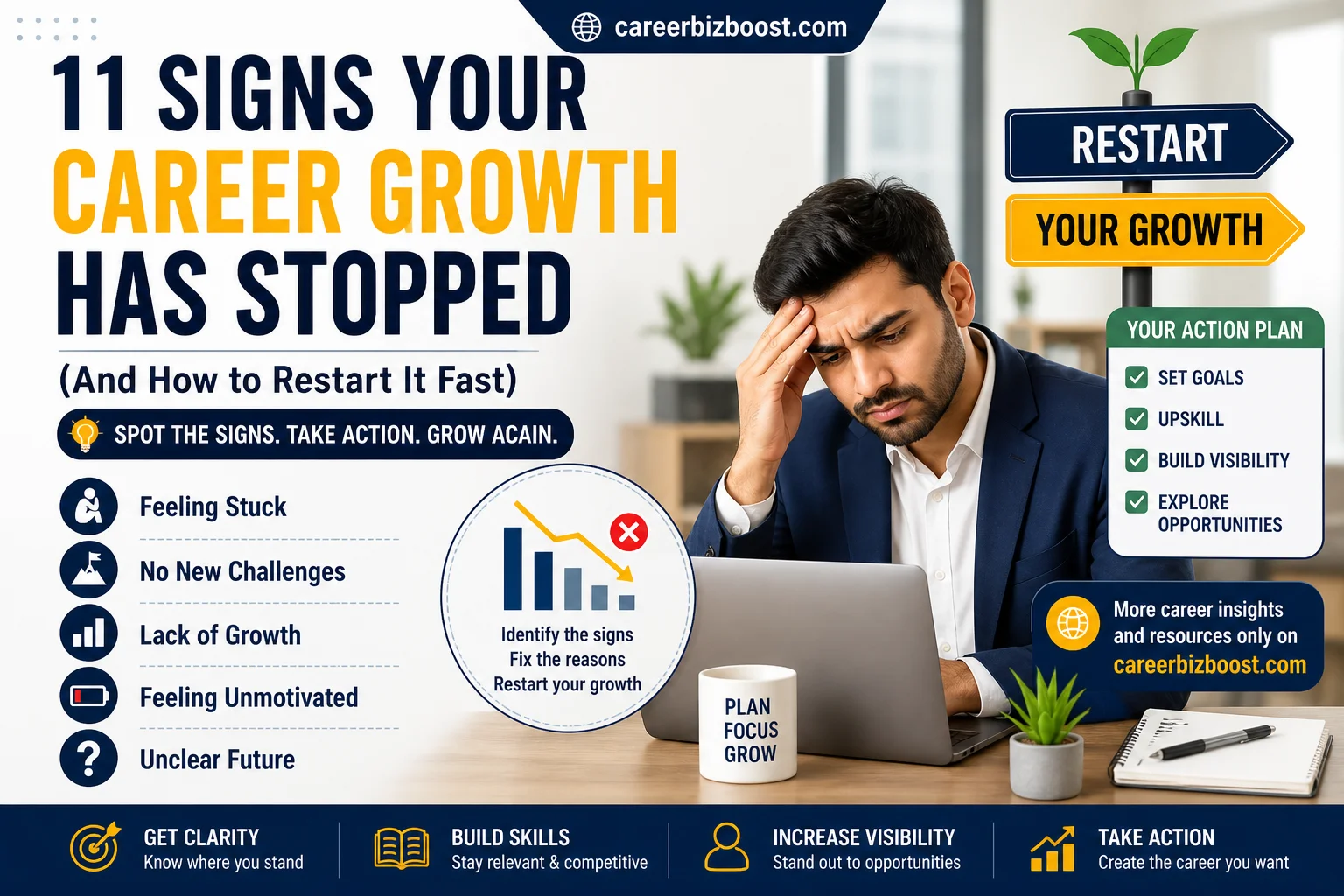
Why This Problem Is More Serious Than You Think?
Career stagnation is not just a temporary inconvenience—it compounds over time.
While you stay in the same place:
- Others gain new skills
- Others increase their earning potential
- Others build stronger professional networks
And the gap widens.
This is exactly why many professionals suddenly feel “left behind” after 3–5 years—even though they’ve been working consistently.
What You’ll Learn in This Guide?
This isn’t another generic career advice article.
In this guide, you’ll discover:
- 11 clear and practical signs your career growth has stopped
- The hidden reasons most professionals overlook
- A step-by-step system to restart your career momentum
- How to decide whether to grow where you are—or move on
By the end, you won’t just have clarity—you’ll have a practical direction forward.
Let’s start by identifying the signals most people ignore.
11 Clear Signs Your Career Growth Has Stopped
Not all career stagnation is obvious.
In fact, most professionals don’t realize their growth has stalled until they’ve already lost valuable time.
Use the signs below as a self-assessment. The more you relate to, the stronger the signal that your career growth has stopped.
1. You Haven’t Learned Anything New in the Last 6–12 Months
Growth always leaves a trail of learning.
If you can’t point to new skills, tools, or knowledge you’ve gained recently, it’s a clear warning sign.
Quick check:
Can you list 3 new skills you’ve developed in the past 6 months?
Micro-action:
Start with one high-impact skill.
2. Your Work Feels Repetitive and Predictable
When every week looks the same, your growth curve is flat.
Repetition creates comfort—but it also limits exposure to new challenges.
Quick check:
Are you solving the same type of problems every day?
Micro-action:
Volunteer for cross-functional projects or stretch assignments—even small ones can restart momentum.
3. Promotions Keep Passing You By
If others with similar experience are moving ahead while you stay in the same role, it’s not random.
It usually means:
- Your value isn’t visible
- Or your growth has plateaued
Quick check:
When was the last time you were seriously considered for a promotion?
Micro-action:
Have a direct conversation with your manager about growth expectations and gaps.
4. Your Salary Hasn’t Increased Meaningfully
Income growth is one of the clearest indicators of career progression.
If your salary has remained stagnant despite consistent performance, your market value may not be increasing.
Quick check:
Has your compensation improved in proportion to your experience?
Micro-action:
Learn how to position your value effectively using proven salary negotiation strategies.
5. You Feel Mentally Disengaged at Work
You’re doing the work—but without energy or enthusiasm.
This often shows up before visible stagnation.
Quick check:
Do you feel excited about your work—or just obligated?
Micro-action:
Identify which parts of your work still interest you. That’s where your next growth direction may lie.
6. You Avoid New Responsibilities
This one is subtle—but critical.
When you stop seeking challenges, growth naturally slows down.
Quick check:
Do you hesitate when new responsibilities are offered?
Micro-action:
Say “yes” to one uncomfortable opportunity this week. Growth starts there.
7. Your Skills Are Becoming Outdated
Industries evolve quickly. If your skills stay the same, your relevance decreases.
Quick check:
Are your skills aligned with current market demand?
Micro-action:
Audit job descriptions in your field and identify missing skills you need to build.
8. You Don’t Have a Clear Career Direction
Without direction, effort becomes scattered.
You may be working hard—but not moving forward.
Quick check:
Can you clearly define your next career goal?
Micro-action:
If not, start by building career clarity with a structured approach.
9. You Rely Only on Your Job for Growth
If your entire growth depends on your current role, you’re limiting your potential.
The most successful professionals grow beyond their job descriptions.
Quick check:
Are you learning or building anything outside your job?
Micro-action:
Start a side project, certification, or portfolio to expand your opportunities.
10. You Constantly Think About Quitting
Frequent thoughts about leaving your job are not random—they’re signals.
They often indicate deeper dissatisfaction or lack of progress.
Quick check:
Do you regularly imagine leaving your current role?
Micro-action:
Before making a decision, evaluate your situation using this should I quit my job quiz.
11. You’re Comfortable—but Not Fulfilled
This is the most dangerous stage.
You’re not struggling—but you’re not growing either.
And because things feel “okay,” you delay taking action.
Quick check:
Are you staying because it’s easy—not because it’s right?
Micro-action:
Challenge your comfort zone intentionally. Growth requires friction.
Quick Reality Check
If you relate to 4 or more signs, your career growth has likely slowed significantly.
If you relate to 7 or more, you’re in a clear stagnation phase—and it’s time to act.
At this point, many professionals start questioning their direction, confidence, and next steps. If that’s where you are right now, take a few minutes to assess your situation using career confidence test.
Now that you’ve identified the signs, the next step is understanding why this happens in the first place—because fixing the problem requires addressing the root cause.
The Hidden Reasons Why Your Career Growth Has Stopped
Here’s the truth most people miss:
Career stagnation is rarely caused by a lack of effort.
It’s usually caused by a lack of strategy, visibility, and direction.
Let’s break down the real reasons your career growth has stopped—so you can fix the root problem, not just the symptoms.
1. You’re Working Hard—But Without a Clear Strategy
This is the most common trap.
You’re busy. You’re productive. You’re reliable.
But you’re not intentionally moving toward a defined goal.
Without a strategy:
- Effort becomes scattered
- Progress becomes slow
- Growth becomes accidental
Reality check:
If someone asked you, “Where do you want your career to be in 2 years?”—would you have a clear answer?
If not, that lack of direction is likely slowing you down.
What to do instead:
Start by defining a clear path. If you’re unsure how to do that, the guide on building career clarity will help you create a structured direction.
2. You’ve Become Too Comfortable in Your Current Role
Comfort feels safe—but it quietly blocks growth.
When you stay too long in a role where:
- You know everything
- You’re rarely challenged
- You’re not being stretched
Your learning curve flattens.
And once that happens, your career growth has effectively stopped—even if your job feels stable.
Reality check:
Are you staying because you’re growing—or because it’s familiar?
What to do instead:
Deliberately introduce discomfort:
- Take on new responsibilities
- Learn unfamiliar skills
- Explore roles outside your comfort zone
3. Your Work Is Not Visible to Decision-Makers
You may be doing great work—but if the right people don’t see it, it won’t translate into growth.
This is where many professionals get stuck:
- They assume hard work speaks for itself
- They avoid self-promotion
- They stay “behind the scenes”
Unfortunately, visibility matters.
Especially in competitive environments.
Reality check:
Would senior leaders know your impact without being told?
What to do instead:
Improve how you position yourself professionally. A strong online presence plays a huge role here. Start by optimizing your profile using these proven LinkedIn profile optimization strategies.
4. You Haven’t Upgraded Your Skills Strategically
Experience alone is no longer enough.
The market rewards:
- Relevant skills
- Modern tools
- Adaptability
If your skillset hasn’t evolved, your value in the job market may be declining—even if your experience is increasing.
Reality check:
Are your skills aligned with what employers are currently demanding?
What to do instead:
Focus on high-impact, future-ready skills. The guide on how to upskill with AI can help you stay competitive.
5. You’re Waiting for Opportunities Instead of Creating Them
One of the biggest myths in career growth:
“If I work hard, I’ll eventually be recognized.”
Sometimes that happens.
But often, it doesn’t.
Growth usually comes from:
- Asking for opportunities
- Positioning yourself for roles
- Exploring options beyond your current job
Reality check:
Are you actively creating opportunities—or passively waiting for them?
What to do instead:
Expand your approach using proven modern job search strategies that go beyond traditional applications.
6. Fear Is Quietly Holding You Back
Fear doesn’t always look obvious.
It shows up as:
- “I’m not ready yet”
- “What if I fail?”
- “Maybe later”
This hesitation delays action—and over time, slows growth.
Reality check:
What decision have you been postponing for months?
What to do instead:
Break the cycle by taking small, calculated risks. Growth rarely happens inside your comfort zone.
7. You Don’t Have a Strong External Market Position
Many professionals focus only on internal growth within their company.
But your external market value matters just as much.
If you’re not:
- Updating your resume
- Building your network
- Exploring opportunities
You may not even realize your growth has stopped—until it’s too late.
Reality check:
If you applied for jobs today, would your profile stand out?
What to do instead:
Strengthen your positioning with a strong ATS-friendly resume that reflects your current value.
8. You’re Confusing Stability with Progress
This is a subtle but powerful mindset shift.
Just because your job is stable doesn’t mean your career is progressing.
Stability gives you security.
Growth gives you options.
And in today’s job market, options matter more than stability.
Reality check:
Are you growing—or just maintaining your current position?
The Bottom Line
If your career growth has stopped, it’s rarely due to a single reason.
It’s usually a combination of:
- Lack of direction
- Limited visibility
- Outdated skills
- Passive career management
The good news?
Every one of these is fixable.
But only if you take intentional action.
Now that you understand why your growth has stalled, the next step is learning exactly how to restart it—with a clear, practical system you can follow.
How to Restart Your Career Growth (A Practical Step-by-Step System)
Recognizing that your career growth has stopped is important—but it’s only the first step.
What actually changes your trajectory is intentional action.
You don’t need to overhaul your entire career overnight. You just need a clear, structured system to rebuild momentum—one step at a time.
Step 1: Diagnose Your Current Situation Honestly
Before making any decisions, you need clarity.
Not assumptions. Not guesses. Clarity.
Ask yourself:
- Which of the signs in the previous section apply to me?
- What exactly is missing—skills, direction, visibility, or opportunity?
- Am I stuck because of my environment—or my approach?
Most professionals skip this step and jump straight into action—which leads to more confusion.
What to do instead:
Use a structured evaluation to understand where you stand. This career confidence test will help you assess your readiness, mindset, and gaps clearly.
Step 2: Define a Clear Career Direction
You cannot grow if you don’t know where you’re going.
A lack of direction is one of the biggest reasons career growth stops.
Without a clear goal:
- You take random actions
- You say yes to the wrong opportunities
- You stay busy—but not effective
What to do instead:
Define:
- Your next role (not just job title, but skill level)
- The industry or niche you want to grow in
- The type of work that aligns with your strengths
Step 3: Upgrade Your Skills Strategically (Not Randomly)
Many people try to “learn more” when they feel stuck.
But random learning doesn’t lead to growth—targeted skill building does.
Focus on:
- Skills that are in demand in your industry
- Skills that align with your next role
- Skills that increase your earning potential
What to do instead:
Start small but strategic. Choose one high-impact area and go deep.
If you want to stay relevant in today’s evolving market, especially with automation and AI, our guide on how to upskill with AI is a strong starting point.
Step 4: Improve Your Visibility and Personal Brand
You may already have the skills.
But if no one knows about them, they won’t create opportunities.
Career growth is not just about value—it’s about visible value.
This includes:
- How you present yourself internally
- How you position yourself externally
- How recruiters and decision-makers perceive you
What to do instead:
Start with your online presence.
A well-optimized LinkedIn profile can significantly increase your visibility and opportunities. Follow these proven LinkedIn profile optimization strategies to stand out.
Step 5: Strengthen Your Professional Positioning
Your resume and professional profile should reflect your current value—not just your past responsibilities.
If your positioning is weak:
- You’ll miss opportunities
- You’ll get overlooked
- You’ll struggle to move forward
What to do instead:
Upgrade your resume to reflect impact, results, and relevance.
Our guide on creating an ATS-friendly resume will help you align your profile with what recruiters are actually looking for.
Step 6: Expand Your Opportunities Beyond Your Current Job
One of the biggest mistakes professionals make is depending entirely on their current employer for growth.
That’s risky.
Because if growth opportunities don’t exist there—you stay stuck.
What to do instead:
Start exploring:
- External job opportunities
- Freelance or part-time work
- Networking and hidden opportunities
Step 7: Take Consistent, Small Actions (Momentum Matters)
You don’t need one big breakthrough.
You need consistent progress.
Career growth is built through:
- Small skill upgrades
- Small visibility improvements
- Small strategic decisions
Over time, these compound into significant results.
What to do instead:
Set weekly goals:
- Apply to 3–5 relevant opportunities
- Learn one new skill
- Improve one part of your professional profile
Consistency beats intensity every time.
A Simple 30-Day Career Reset Plan
If your career growth has stopped, here’s a simple way to restart momentum quickly:
Week 1: Self-assessment + clarity
Week 2: Skill upgrade + learning
Week 3: Resume + LinkedIn optimization
Week 4: Job search + networking
This structured approach helps you move from confusion to clarity—and from stagnation to action.
When This System Works Best
This approach is especially effective if:
- You feel stuck but don’t want to quit immediately
- You’re unsure about your next move
- You want to increase your opportunities before making a big decision
The Key Takeaway
If your career growth has stopped, the solution is not to “wait and hope.”
It’s to:
- Get clarity
- Build strategy
- Take consistent action
That’s how momentum is created.
Final Thoughts: Your Career Growth Has Stopped—But It Doesn’t Have to Stay That Way
If you’ve made it this far, one thing is clear:
You’re not ignoring the problem anymore.
And that alone puts you ahead of most professionals who stay stuck for years without taking action.
Because here’s the truth—
When your career growth has stopped, it’s rarely permanent.
But it will become permanent if you don’t respond to it.
Your Next Career Move Should Be Intentional
Staying where you are might feel safe.
But real growth comes from making deliberate choices—not waiting for the right moment.
Because the right moment?
It’s usually the one where you decide to take action.
Now it’s your move.
Frequently Asked Questions About Career Growth Stagnation
How do I know if my career growth has stopped?
You’ll notice a combination of signals such as:
No new skills or learning in recent months
Lack of promotions or salary growth
Repetitive work with no new challenges
Feeling disengaged or unmotivated
If you relate to multiple signs, your growth may have slowed significantly. Many professionals first recognize this through emotional patterns like feeling stuck in your career, which often appear before visible career stagnation.
Is it normal for career growth to slow down?
Yes, temporary slowdowns are normal.
However, long-term stagnation is not.
Career growth naturally comes in phases:
Learning phase
Growth phase
Plateau phase
The problem starts when you stay in the plateau phase too long without taking action.
What should I do if I feel stuck but don’t want to quit my job?
You don’t always need to quit.
In many cases, growth can be restarted by:
Learning new skills
Taking on additional responsibilities
Improving your visibility
Exploring internal opportunities
Start by building career clarity so your actions align with your long-term goals.
Can changing jobs fix career stagnation?
Sometimes—but not always.
If the root problem is:
Lack of direction
Skill gaps
Poor positioning
Then changing jobs alone won’t solve it.
You may carry the same problem into a new role.
Before making a move, evaluate your situation using this career confidence test to make a more informed decision.
How long should I stay in a job without growth?
There’s no fixed rule, but a general guideline is:
If there’s no meaningful growth after 12–18 months, it’s worth reassessing your situation
Look for:
Learning opportunities
Role expansion
Compensation growth
If none of these are present, your career growth may have stopped.
What skills should I learn to restart my career growth?
Focus on skills that:
Are in demand in your industry
Align with your next career step
Increase your earning potential
Right now, one of the most impactful areas is learning how to leverage AI in your work.
Should I quit my job if I feel stuck?
Not immediately.
First, identify the root cause of your stagnation:
Is it the role?
The company?
Or the career path itself?
Once you have clarity, you can make a better decision.
How can I improve my career growth opportunities quickly?
Focus on three high-impact areas:
Skill development
Visibility (especially online presence)
Strategic job exploration
Improving your professional presence using LinkedIn profile optimization techniques can significantly increase your chances of attracting better opportunities.
Final Note
Career stagnation is more common than you think—but staying stuck is a choice.
Once you recognize the signs and take action, you can rebuild momentum faster than you expect.
