Career Acceleration vs Stability: Why Smart Professionals Choose Growth Over Comfort
This post may contain affiliate links. At no extra cost to you, I may earn a small commission if you make a purchase. Read full disclosure »
Introduction
For decades, professionals were taught that stability was the ultimate career goal.
Get a secure job.
Stay loyal.
Avoid risks.
Wait patiently for promotions.
That approach worked reasonably well in slower, more predictable economies. But today’s professional landscape looks completely different.
Industries evolve faster. Skills expire quicker. Companies restructure unexpectedly. Artificial intelligence is transforming workflows. Entire roles are changing within a few years.
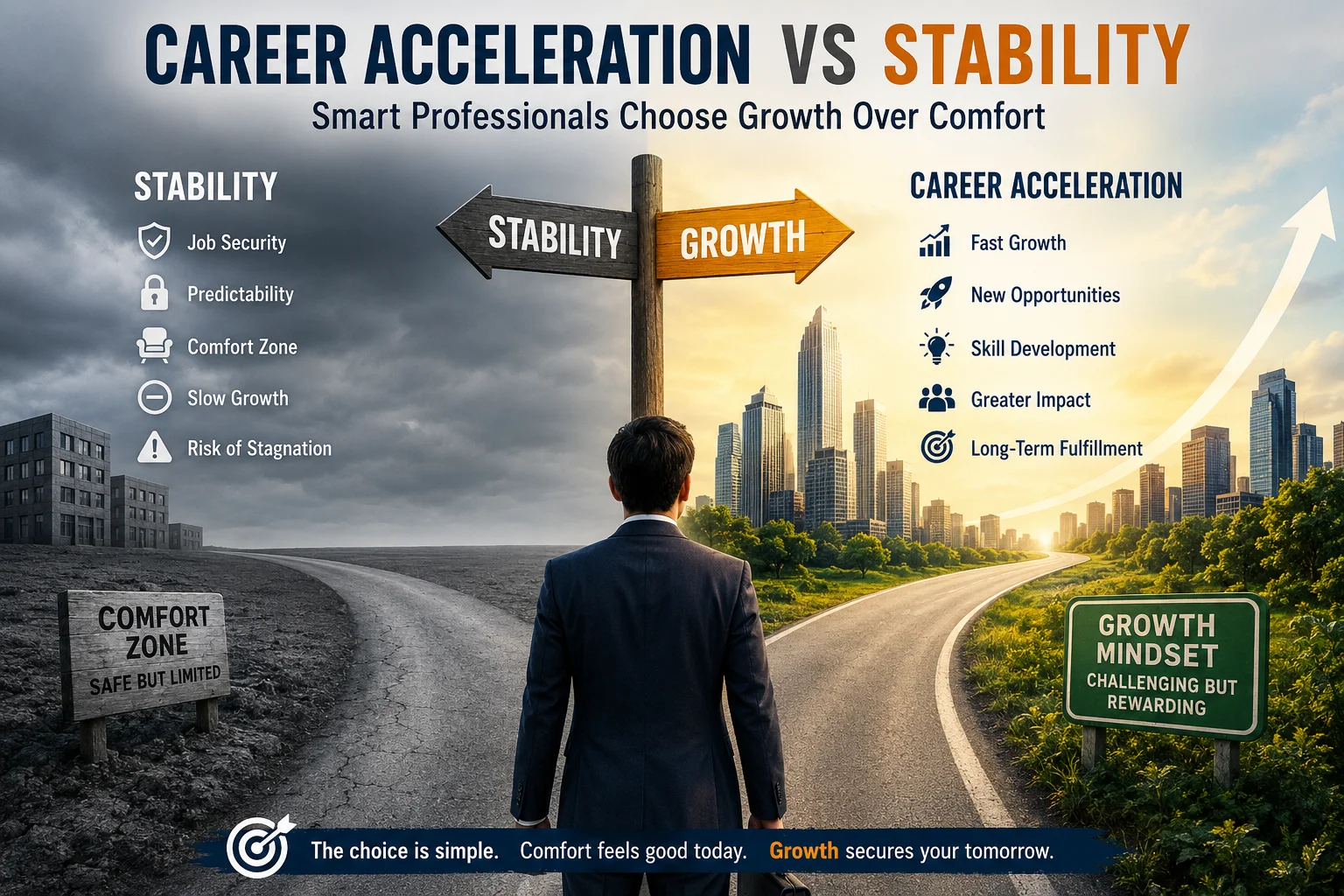
In this environment, the debate around career acceleration vs stability has become more important than ever.
Many professionals still chase comfort and predictability, believing that stability guarantees safety. Ironically, that mindset often creates long-term career stagnation instead of protection.
Meanwhile, ambitious professionals are taking a different approach. They are focusing on visibility, adaptability, strategic growth, and continuous learning. They are intentionally building momentum instead of simply maintaining employment.
This doesn’t mean reckless job hopping or abandoning security altogether. It means understanding that long-term career success often comes from growth-oriented decisions rather than remaining in a prolonged comfort zone.
The conversation around career stability vs growth is no longer theoretical. It directly affects:
- income potential
- future opportunities
- professional relevance
- confidence
- leadership visibility
- long-term employability
Smart professionals are realizing that waiting for external validation is risky. Instead, they are actively building skills, influence, networks, and opportunities before career stagnation sets in.
For professionals who want a more structured approach to accelerating career growth, the interactive Course on Career Acceleration Plan – 90-Day Framework provides a practical roadmap focused on visibility, positioning, momentum, and strategic execution. It is designed to help professionals move beyond passive career management and take deliberate action toward long-term advancement.
The reality is simple:
stability without progress eventually becomes vulnerability.
That is why more professionals are developing a stronger career acceleration mindset — one focused on proactive growth, strategic positioning, and long-term adaptability.
In this article, we will explore:
- the real difference between stability and career acceleration
- why comfort zones quietly limit professional growth
- the hidden risks of staying stagnant
- how to balance security with ambition
- why accelerated growth often creates better long-term stability
We will also answer one of the biggest professional questions people face today:
Should you prioritize career growth or stability?
The answer may redefine how you think about your future career decisions.
The Problem With Chasing Stability Forever
At first glance, stability feels like the responsible choice.
A predictable salary, familiar routines, manageable expectations, and low uncertainty can create a sense of comfort that many professionals naturally seek. There is nothing wrong with wanting security. In fact, financial and professional stability matter.
The problem begins when stability quietly turns into stagnation.
This is where the conversation around career acceleration vs stability becomes more nuanced. Many professionals assume they are protecting their future by avoiding change, but in reality, they may be limiting their long-term growth potential.
A role that once felt safe can slowly become restrictive.
You stop learning aggressively.
You stop challenging yourself.
You stop building visibility.
Your network becomes smaller.
Your confidence becomes tied to familiarity rather than adaptability.
Over time, comfort becomes dependency.
One of the biggest misconceptions in the debate around career stability vs growth is the belief that staying in the same environment automatically guarantees security. But modern careers do not work that way anymore.
Companies evolve constantly. Industries shift unexpectedly. Skills become outdated faster than ever before. Even high-performing employees can suddenly face restructuring, automation, leadership changes, or budget cuts.
In many cases, professionals who spent years prioritizing stability discover they are no longer competitive in the market because they stopped evolving while the industry kept moving.
This is one of the hidden risks of staying in the comfort zone that people rarely discuss openly.
Comfort zones feel safe in the short term because they reduce uncertainty. But over several years, they can quietly reduce:
- market value
- adaptability
- confidence in handling change
- leadership readiness
- earning potential
Ironically, professionals who consistently pursue growth often become more secure in the long run because they build transferable skills, stronger networks, and broader opportunities.
That does not mean you need to make reckless career decisions or constantly switch jobs. Smart career acceleration is strategic, not impulsive.
The real goal is to avoid becoming professionally static.
Remember, meaningful career growth without switching jobs is possible when you focus on developing high-value skills and increasing your impact within your current organization.
Professionals with a strong career acceleration mindset understand that growth itself creates resilience. They continuously improve their skills, increase their visibility, and stay prepared for opportunities before they desperately need them.
When discussing fast career growth vs job security, the answer is rarely extreme. It is not about choosing chaos over stability. It is about understanding that controlled growth often creates stronger long-term stability than remaining comfortable for too long.
This is why more professionals are starting to ask an important question:
Should you prioritize career growth or stability?
The answer depends on whether your current stability is helping you grow — or quietly holding you back.
Why Career Acceleration Creates Better Long-Term Security
One of the biggest ironies in modern careers is this:
The professionals who focus only on stability often become less secure over time, while the professionals who continuously grow become more resilient.
That may sound counterintuitive at first.
After all, stability appears safer on the surface. A predictable routine, a familiar role, and a steady paycheck can create the feeling that everything is under control. But in rapidly changing industries, long-term security rarely comes from standing still.
It comes from remaining valuable.
It comes from remaining valuable.
Professionals who want to understand this shift more deeply can explore What Is Career Acceleration? A Practical Roadmap to Grow Faster, which breaks down how strategic growth, visibility, adaptability, and skill development create stronger long-term career resilience.
This is where the discussion around career acceleration vs stability becomes especially important.
Career acceleration is not just about promotions or salary increases. It is about intentionally increasing your professional value over time. Professionals who focus on growth tend to:
- learn faster
- adapt quicker
- build stronger networks
- improve communication skills
- become more visible inside organizations
- stay aligned with industry changes
These factors create leverage.
If one opportunity disappears, another becomes possible because their skills and reputation continue to evolve.
Once you’ve decided to prioritize growth, these career acceleration strategies can help you increase your salary and advance faster.
Meanwhile, professionals who remain in the same comfort zone for too long often struggle when unexpected change happens. Even small disruptions can feel overwhelming because their confidence is built around familiarity rather than adaptability.
This is one of the overlooked realities in the debate around career stability vs growth.
True career security today is not about avoiding change altogether. It is about becoming capable of handling change confidently.
That shift in thinking is powerful.
For example, imagine two professionals with similar experience levels.
The first professional prioritizes predictability above everything else. They avoid difficult projects, resist learning new systems, and stay invisible outside their immediate responsibilities.
The second professional takes a different approach. They actively develop new skills, participate in visible projects, improve leadership abilities, and continuously expand their professional network.
Initially, the first person may feel more comfortable.
But five years later, the second professional usually has:
- stronger opportunities
- higher earning potential
- better adaptability
- more career options
- greater confidence during uncertainty
This is why many ambitious professionals eventually realize that controlled growth creates better protection than passive stability.
The conversation should not simply be about fast career growth vs job security. The smarter question is:
What kind of professional foundation are you building for the future?
Because industries will continue evolving whether you prepare for them or not.
A strong career acceleration mindset helps professionals stay proactive instead of reactive. Rather than waiting for problems to appear, they continuously invest in growth before career stagnation becomes visible.
This mindset becomes especially important during uncertain economic periods. Companies may reduce teams, restructure departments, or automate workflows. Professionals who remain adaptable usually recover faster because their value extends beyond a single role or organization.
That is why career acceleration is not just about ambition.
It is increasingly becoming a form of long-term career insurance.
The Hidden Risks of Staying in Your Comfort Zone
Most comfort zones do not feel dangerous in the beginning.
They feel efficient.
You know your responsibilities.
You understand the systems.
People trust your work.
The routine becomes predictable.
From the outside, everything appears stable.
But this is exactly why the risks of staying in the comfort zone are often ignored for too long. Career stagnation rarely happens suddenly. It develops quietly through repetition, predictability, and reduced professional challenge.
Over time, many professionals stop realizing how much they have stopped growing.
This is one of the most important lessons in the debate around career acceleration vs stability. Stability becomes risky when it prevents adaptation.
A comfortable role can slowly reduce curiosity. You stop seeking difficult assignments because you already know how to perform your current responsibilities well. Learning becomes optional instead of necessary.
At first, this feels harmless.
But industries continue evolving whether you evolve or not.
New technologies emerge.
Work expectations change.
Leadership standards shift.
Communication styles evolve.
AI and automation reshape workflows.
Professionals who remain too comfortable often realize too late that their skills are no longer as competitive as they once were.
Another hidden problem is reduced visibility.
Many highly capable employees remain professionally invisible because they avoid stretching beyond familiar responsibilities. They perform well but rarely position themselves strategically inside the organization.
As a result:
- leadership opportunities pass them by
- promotions slow down
- influence decreases
- professional confidence weakens over time
This is why career stability vs growth is not just about income or promotions. It is also about maintaining relevance and momentum.
There is also a psychological cost to staying comfortable for too long.
The longer people avoid uncertainty, the more intimidating change becomes.
Simple career moves that once felt manageable — speaking publicly, leading projects, networking, changing roles, learning new tools — can suddenly feel overwhelming after years of routine.
This creates dependency on familiarity instead of confidence in adaptability.
Professionals with a strong career acceleration mindset approach things differently. They intentionally expose themselves to growth situations before they feel fully ready.
They:
- volunteer for visible projects
- develop new skills continuously
- improve communication abilities
- expand professional relationships
- take calculated career risks
- embrace learning discomfort
This does not mean they constantly live under pressure. It means they understand that moderate discomfort often produces long-term career strength.
One of the biggest myths surrounding fast career growth vs job security is the idea that avoiding risk creates safety. In reality, refusing to grow can become one of the biggest professional risks of all.
The modern workplace rewards adaptability far more than passive consistency.
That is why smart professionals do not simply ask:
“How do I stay comfortable?”
They ask:
“How do I continue becoming more valuable?”
This is one of the most common career questions professionals struggle with:
Should you prioritize career growth or stability?
The honest answer is that both matter. The real challenge is knowing which one you need more at a particular stage of your career.
The problem is that many people think growth and stability are complete opposites. In reality, the best long-term careers usually combine both — but not equally at every stage.
Early in a career, growth often matters more.
This is the phase where professionals build:
- skills
- confidence
- visibility
- adaptability
- communication abilities
- leadership potential
Choosing only comfort too early can slow long-term progress significantly. Professionals who avoid challenge during their growth years often struggle to catch up later.
This is why many ambitious individuals lean toward career acceleration vs stability during the early and middle stages of their careers. They understand that building momentum now creates more options later.
That does not mean making reckless decisions or constantly chasing titles.
Strategic career acceleration is intentional. It focuses on:
- learning valuable skills
- increasing professional exposure
- improving influence
- expanding opportunities
- building long-term leverage
At the same time, stability still has value.
There are seasons in life when financial predictability, family responsibilities, health considerations, or burnout recovery may require a more stable professional environment. Choosing temporary stability is not failure.
The key difference is whether stability is being used intentionally or whether it has become an excuse to avoid growth.
That distinction matters.
Many professionals stay in unsatisfying situations for years because uncertainty feels uncomfortable. They convince themselves they are being practical, even when they know they have stopped progressing.
This is where the conversation around career stability vs growth becomes deeply personal.
Sometimes stability protects you.
Sometimes it limits you.
The goal is not to constantly pursue aggressive change. The goal is to avoid becoming professionally passive.
A healthy career acceleration mindset recognizes that growth does not always require dramatic moves. Often, small consistent actions create significant long-term results.
For example:
- improving communication skills
- learning industry tools
- becoming more visible internally
- building relationships
- strengthening personal branding
- leading initiatives
- developing strategic thinking
These are forms of career acceleration that improve future stability rather than threaten it.
Professionals who balance growth with strategic decision-making usually create stronger careers over time because they are prepared for opportunities before they arrive.
The debate around fast career growth vs job security should not be framed as ambition versus responsibility.
A better question is:
Are you building a career that can adapt, evolve, and remain valuable in the future?
Because in today’s economy, adaptability itself has become one of the most important forms of security.
The Career Acceleration Mindset That Separates High Performers
When people think about career acceleration, they often focus only on external results:
- promotions
- salary increases
- better job titles
- leadership positions
But long-term career growth usually starts with something less visible first — mindset.
A strong career acceleration mindset changes how professionals approach opportunities, challenges, and uncertainty. Instead of waiting passively for recognition, they actively create momentum.
This is one of the biggest differences in the debate around career acceleration vs stability.
Professionals focused only on stability often ask:
“How do I avoid problems?”
Growth-oriented professionals ask:
“How do I increase my value?”
That shift in thinking changes career outcomes dramatically over time.
High performers understand that modern careers reward adaptability more than predictability. They do not assume their current role will protect them forever. Instead, they continuously improve their ability to remain relevant in changing environments.
This mindset influences daily behavior in subtle but powerful ways.
For example, professionals with strong career acceleration habits tend to:
- seek feedback regularly
- learn beyond their job description
- improve communication skills intentionally
- volunteer for visible projects
- build strategic relationships
- stay informed about industry changes
- develop leadership presence early
These actions may appear small individually, but together they create significant professional momentum.
Meanwhile, professionals trapped in long-term comfort zones often become reactive. They wait for:
- promotions
- opportunities
- recognition
- direction from management
Unfortunately, modern workplaces rarely reward passive career management for long periods.
This is one reason why career stability vs growth has become such an important conversation today. Growth-oriented professionals are not necessarily working harder all the time — they are often working more strategically.
They understand that visibility matters.
Communication matters.
Adaptability matters.
Positioning matters.
A major part of the career acceleration mindset is becoming comfortable with temporary discomfort.
Growth frequently requires moments where you:
- feel inexperienced
- face uncertainty
- take calculated risks
- enter unfamiliar situations
- challenge your own limitations
Professionals who avoid all discomfort may feel safe temporarily, but they often limit their future opportunities without realizing it.
This does not mean constantly changing jobs or chasing unrealistic ambition. Sustainable career acceleration is about continuous progress, not permanent instability.
In fact, many professionals who achieve strong long-term success build careers through:
- consistent skill development
- strategic visibility
- gradual leadership growth
- reliable execution
- long-term learning habits
The difference is that they refuse to become professionally stagnant.
That is why smart professionals increasingly view growth as a form of protection rather than a threat.
In the modern workplace, your ability to learn, adapt, and evolve may ultimately matter more than how long you stayed comfortable.
How to Pursue Career Acceleration Without Becoming Reckless
One reason some professionals resist growth opportunities is because they associate career acceleration with instability.
They imagine:
- quitting jobs impulsively
- chasing titles constantly
- overworking endlessly
- taking unnecessary risks
- sacrificing personal balance
But sustainable career growth does not require chaos.
In fact, the smartest professionals approach career acceleration vs stability with strategy, not emotion. They focus on calculated progress instead of reactive decision-making.
This distinction matters.
There is a major difference between:
- intentional career acceleration
and - impulsive career movement
Unfortunately, many online career conversations glorify constant hustle without discussing long-term sustainability. Real career acceleration is far more practical than that.
It is about building momentum while still protecting your long-term well-being.
Professionals with a healthy career acceleration mindset usually grow through deliberate actions such as:
- strengthening high-value skills
- improving visibility
- developing leadership abilities
- expanding professional networks
- increasing adaptability
- positioning themselves for future opportunities
None of these require reckless decisions.
For example, you do not need to resign immediately to prioritize growth. Sometimes career acceleration happens within your current organization through:
- leading initiatives
- improving communication
- solving larger business problems
- becoming more visible to leadership
- developing cross-functional expertise
This is where the conversation around career stability vs growth becomes more balanced.
Growth should not destroy stability.
Ideally, it should strengthen it over time.
The key is avoiding prolonged stagnation while making thoughtful decisions based on long-term goals rather than short-term emotions.
One of the smartest approaches is to think in phases instead of extremes.
There may be periods where you focus heavily on acceleration:
- learning aggressively
- taking stretch opportunities
- increasing visibility
- expanding responsibilities
And there may be periods where you prioritize consolidation:
- improving work-life balance
- stabilizing finances
- recovering from burnout
- strengthening personal priorities
Both phases are normal.
The danger appears when professionals stop growing entirely because comfort becomes addictive.
This is one of the biggest risks of staying in the comfort zone. Over time, avoiding uncertainty can slowly weaken confidence in handling change.
Meanwhile, professionals who consistently challenge themselves in manageable ways tend to become more resilient, adaptable, and confident.
That is why the debate around fast career growth vs job security should not be treated as a binary choice.
You do not need to choose between:
- ambition
and - stability
You need a career strategy that allows growth while maintaining long-term sustainability.
The professionals who succeed long term are usually not the most reckless people in the room.
They are the people who continue evolving while others remain professionally static.
Conclusion: Growth Is No Longer Optional in Modern Careers
The workplace has changed dramatically over the last decade.
Industries evolve faster.
Technology reshapes roles constantly.
Competition is global.
Skills become outdated more quickly than ever before.
In this environment, the conversation around career acceleration vs stability is no longer just about ambition. It is about long-term professional survival and relevance.
Stability still matters. Financial security, balance, and consistency are important parts of a healthy career. But stability without growth can quietly become one of the biggest professional risks in the modern workplace.
That is why more professionals are shifting toward a stronger career acceleration mindset.
They are not chasing growth because they enjoy constant pressure. They are doing it because they understand that adaptability creates resilience.
Professionals who continue learning, improving, and expanding their value tend to build:
- stronger career security
- better opportunities
- higher earning potential
- greater confidence during uncertainty
- more control over their future
Meanwhile, professionals who remain in prolonged comfort zones often discover that avoiding change does not eliminate risk — it simply delays it.
This is one of the most important lessons in the debate around career stability vs growth.
The goal is not reckless ambition.
The goal is intentional progress.
You do not need to transform your career overnight. Small strategic actions repeated consistently often create extraordinary long-term results.
Improving communication skills.
Building visibility.
Learning modern tools.
Developing leadership abilities.
Expanding your network.
Taking calculated opportunities.
These are all forms of sustainable career acceleration.
If you are still wondering, should you prioritize career growth or stability, the answer may be simpler than it first appears:
Choose the kind of stability that comes from becoming adaptable, valuable, and difficult to replace — not the kind that depends entirely on remaining comfortable.
Because in today’s world, long-term career security increasingly belongs to professionals who continue evolving.