12 Remote Work Challenges Nobody Warns You About (And Smart Solutions That Actually Work)
This post may contain affiliate links. At no extra cost to you, I may earn a small commission if you make a purchase. Read full disclosure »
Introduction
Remote work promised freedom.
No commute. Flexible schedules. More control over your day.
But for many professionals, the reality looks very different after a few months.
The modern workplace may have moved online, but human challenges did not disappear with office walls. In fact, many remote work challenges have become more intense because work now follows people everywhere — into bedrooms, weekends, vacations, and even late-night screen time.
Remote employees today struggle less with technology and more with sustainability.
Burnout.
Distraction.
Communication overload.
Isolation.
Blurred work-life boundaries.
Mental fatigue from constant notifications.
These problems quietly reduce productivity long before people realize what is happening.
After years of freelancing and managing distributed projects, one pattern becomes very clear: successful remote work depends less on motivation and more on systems.
The professionals who thrive remotely usually build:
- stronger routines
- better communication habits
- intentional boundaries
- sustainable focus systems
This guide breaks down the biggest remote work challenges affecting professionals today — along with practical strategies that actually help.
Whether you are:
- a freelancer
- remote employee
- hybrid worker
- solopreneur
- beginner transitioning into remote work
these systems can help you work remotely without constantly feeling exhausted.
Why Remote Work Feels Harder Than Expected
One of the biggest misconceptions about remote work is that flexibility automatically creates productivity.
It does not.
Without structure, flexibility often turns into:
- inconsistent routines
- overworking
- constant multitasking
- digital exhaustion
- reduced focus
At first, working remotely feels exciting. You save commute time, control your environment, and gain more freedom over your schedule.
But eventually many professionals discover something unexpected:
When work and life happen in the same physical space, boundaries slowly disappear.
Emails creep into evenings. Slack notifications interrupt meals. Small distractions pile up throughout the day. Deep focus becomes harder to maintain.
Most remote work problems are not caused by laziness or lack of discipline.
They are usually caused by missing systems.
That is why sustainable remote work requires intentional design rather than constant willpower.
If you’re unsure whether remote work matches your skills and work style, take our remote work readiness assessment to identify your strengths and areas for improvement.
The Remote Work Stability Framework
Most remote work advice focuses only on productivity.
But sustainable remote work actually depends on five connected systems.
1. Focus System
Protects attention and reduces distractions.
2. Boundary System
Prevents burnout and overworking.
3. Communication System
Reduces confusion and digital overload.
4. Energy System
Protects mental clarity and emotional recovery.
5. Visibility System
Helps remote professionals grow their careers without becoming invisible.
Whenever one of these systems breaks down, remote work becomes significantly harder to sustain long term.
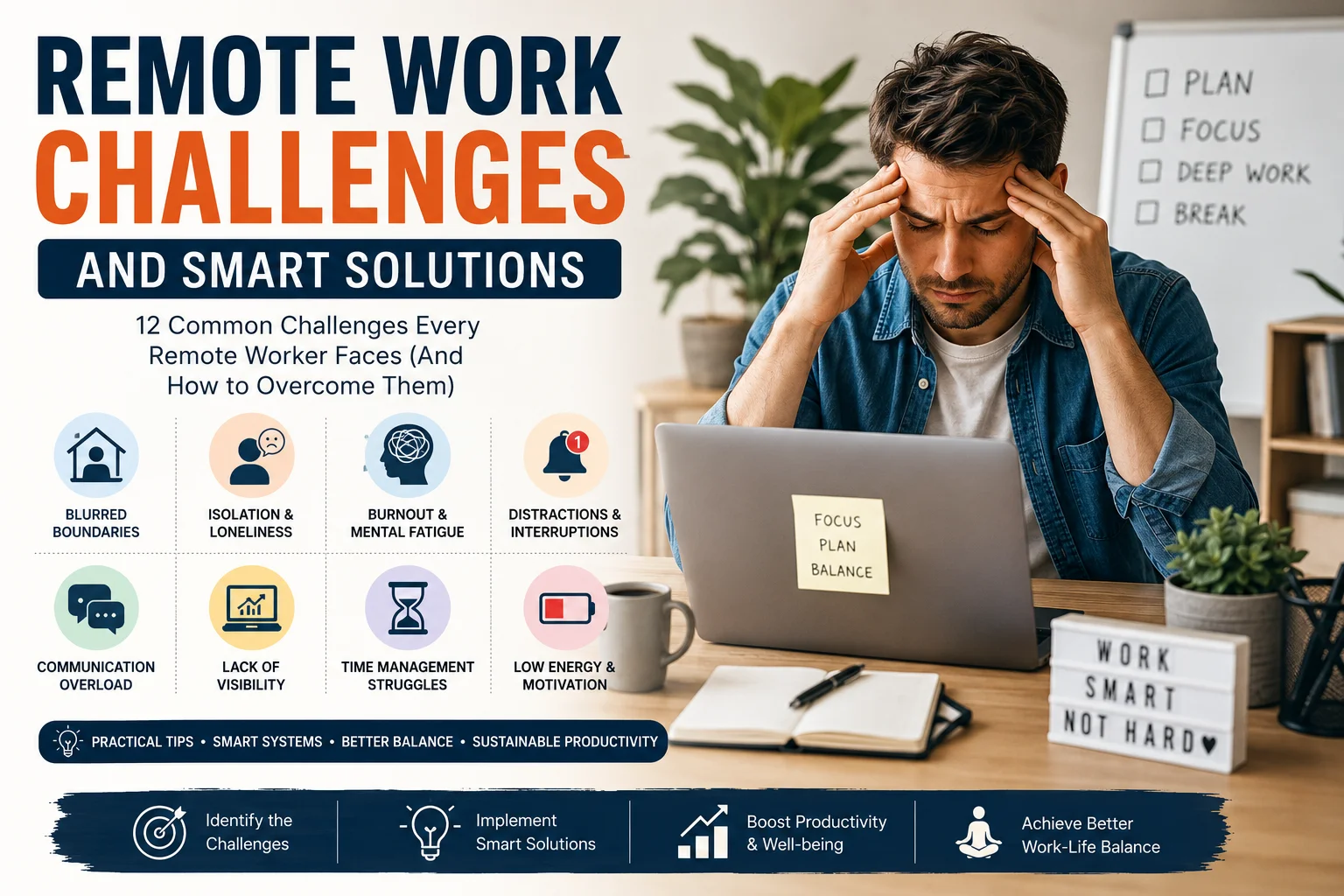
The Actual Remote Work Challenges and Solutions
1. Blurred Boundaries Between Work and Personal Life
One of the most damaging remote work challenges is the gradual disappearance of boundaries.
When your dining table becomes your office, your brain struggles to separate:
- work mode
- rest mode
This often creates a situation where people feel mentally “half working” all day.
Why It Happens
Remote workers often:
- check messages after hours
- respond instantly to notifications
- skip proper shutdown routines
- work from personal spaces constantly
Over time, work quietly expands into every part of life.
Why It Matters
Poor boundaries create:
- chronic mental fatigue
- reduced focus
- emotional exhaustion
- higher burnout risk
Many professionals think they need better time management.
In reality, they often need better separation.
Smart Solutions
- Create fixed start and shutdown times
- Avoid working from bed whenever possible
- Use a short end-of-day ritual
- Turn off notifications after work hours
- Physically close your workspace at the end of the day
Remote work becomes healthier when work stops feeling permanently “open.”
2. Remote Work Burnout and Always-On Culture
Many professionals assume remote work reduces stress.
But for some people, it creates the opposite problem.
Without visible office hours, many workers feel pressure to appear constantly available.
This leads to:
- excessive screen time
- late-night replies
- unhealthy responsiveness
- mental exhaustion
What Most People Get Wrong
Burnout is not always caused by workload.
Often it comes from fragmented attention and lack of recovery.
Constant context switching drains mental energy faster than difficult work itself.
Smart Solutions
- Schedule deep-work blocks daily
- Protect offline recovery time
- Avoid checking Slack constantly
- Batch communication into specific windows
- Stop measuring productivity by online presence
Being constantly reachable is not the same as being effective.
3. Loneliness and Isolation
One of the quieter work from home challenges is isolation.
Remote workers miss:
- casual conversations
- spontaneous collaboration
- social energy
- informal support systems
Freelancers and solopreneurs often experience this even more intensely.
Why Isolation Matters
Long periods of isolation can reduce:
- motivation
- creativity
- confidence
- emotional well-being
People perform better when they feel connected.
Smart Solutions
- Join online professional communities
- Schedule virtual coworking sessions
- Work occasionally from cafés or coworking spaces
- Create recurring social routines
- Build peer accountability systems
Human connection is not optional for sustainable work.
4. Constant Distractions and Reduced Focus
Working from home means competing with:
- phones
- notifications
- household tasks
- social media
- endless tabs
- digital interruptions
Attention becomes fragmented throughout the day.
The Real Productivity Problem
Most professionals do not lack motivation.
They lack protected attention.
Modern remote environments constantly interrupt deep thinking.
Smart Solutions
- Use focus blocks without notifications
- Try Pomodoro sessions
- Write priorities before opening email
- Use distraction blockers
- Separate communication time from execution time
Focus improves when attention becomes intentional.
5. Communication Overload
Remote communication problems often come from too much communication — not too little.
Many teams create:
- excessive meetings
- endless Slack messages
- unnecessary check-ins
- constant notifications
This creates mental overload.
Why It Hurts Productivity
Communication fragmentation destroys deep work.
Employees spend entire days reacting instead of thinking.
Smart Solutions
- Reduce unnecessary meetings
- Use async updates whenever possible
- Create communication guidelines
- Separate urgent vs non-urgent channels
- Encourage concise updates
Good communication creates clarity — not constant interruption.
6. Feeling Invisible in Remote Teams
One major remote employee productivity issue is lack of visibility.
Remote professionals often worry:
- “Does anyone notice my work?”
- “Am I being overlooked?”
- “Will this affect career growth?”
Unlike offices, remote environments remove natural visibility.
Smart Solutions
- Share weekly progress summaries
- Document measurable outcomes
- Schedule regular 1:1 conversations
- Communicate wins clearly
- Build visibility through consistency
Career growth in remote work requires intentional visibility.
7. Digital Fatigue and Zoom Exhaustion
Virtual work challenges are not always physical.
Sometimes the exhaustion comes from:
- nonstop video calls
- screen fatigue
- context switching
- mental overstimulation
Many remote professionals spend entire days reacting to digital inputs.
Smart Solutions
- Keep meetings shorter
- Replace calls with Loom videos when possible
- Schedule no-meeting blocks
- Reduce multitasking during calls
- Take screen breaks intentionally
Your best thinking usually happens away from constant notifications.
8. Lack of Structure and Routine
Remote work freedom can become chaotic without routines.
Many professionals wake up already reacting to:
- emails
- Slack
- meetings
- requests
instead of following intentional workflows.
Smart Solutions
Create a simple daily structure:
- planning time
- deep work time
- communication windows
- recovery breaks
- shutdown routine
Systems reduce mental friction.
9. Remote Collaboration Problems Across Time Zones
Distributed teams often struggle with:
- delayed decisions
- unclear ownership
- waiting for responses
- asynchronous confusion
Smart Solutions
- Define overlapping work hours
- Use async-first workflows
- Record updates clearly
- Document decisions centrally
- Reduce dependency bottlenecks
Strong remote collaboration depends on clarity, not constant availability.
10. Overdependence on Productivity Tools
Many professionals keep adding tools hoping productivity will improve.
But more tools often create:
- fragmentation
- confusion
- mental clutter
Smart Solutions
Use fewer tools more effectively.
Most remote teams only need:
- communication platform
- task manager
- documentation system
- scheduling workflow
Complexity drains energy.
11. Difficulty Disconnecting After Work
Many remote workers physically stop working but mentally continue working.
This creates long-term exhaustion.
Smart Solutions
- Build a clear shutdown ritual
- Avoid late-night email checking
- Separate work devices if possible
- Create transition activities after work
- Protect non-screen recovery time
Recovery is part of productivity.
12. Lack of Long-Term Sustainability
Many people can survive remote work temporarily.
Fewer can sustain it healthily for years.
Sustainable remote work requires:
- boundaries
- communication systems
- emotional recovery
- focus protection
- intentional routines
Without systems, flexibility slowly turns into exhaustion.
What Most Remote Workers Get Wrong
Many professionals believe remote productivity depends mainly on discipline.
But the real issue is usually system design.
Most remote workers do not fail because they are lazy.
They fail because:
- distractions are unmanaged
- communication is fragmented
- boundaries are weak
- routines are inconsistent
- recovery is ignored
The goal is not working harder.
The goal is creating environments where focus becomes easier.
My Biggest Remote Work Mistakes After Years of Freelancing
One of my biggest mistakes early in freelancing was staying constantly available.
I replied instantly to:
- emails
- Slack messages
- client requests
because I believed responsiveness proved professionalism.
Instead, it destroyed deep focus.
Another mistake was multitasking continuously throughout the day. Switching between meetings, writing, planning, and admin tasks created more exhaustion than difficult work itself.
Eventually I realized sustainable remote work depends less on motivation and more on repeatable systems.
The biggest improvements came from:
- fixed work hours
- deeper focus blocks
- fewer notifications
- async communication
- better planning systems
Small structural changes improved productivity far more than working longer hours.
Remote Work Challenges vs Practical Solutions
| Challenge | Main Cause | Practical Solution |
|---|---|---|
| Burnout | No boundaries | Fixed shutdown routine |
| Isolation | Lack of interaction | Weekly coworking |
| Distractions | Poor setup | Focus blocks |
| Communication overload | Too many meetings | Async communication |
Remote Work Challenges vs Office Work Challenges
| Remote Work Challenges | Traditional Office Challenges |
| Isolation and loneliness | Long commutes |
| Blurred boundaries | Office interruptions |
| Communication delays | Rigid schedules |
| Digital fatigue | Office politics |
| Async collaboration | Excessive commuting |
| Overworking | Meeting overload |
Both environments have challenges.
The goal is building systems that protect focus, communication, and sustainability regardless of location.
Frequently Asked Questions (FAQs)
What are the biggest remote work challenges today?
The top remote work challenges include blurred work-life boundaries, isolation, distractions, overcommunication, burnout, time zone delays, and lack of visibility or feedback. These challenges affect both productivity and mental well-being if not addressed.
How do I stay productive while working remotely?
Staying productive while working remotely requires structure, not constant motivation. One of the best ways to improve remote employee productivity is by creating a predictable daily routine. Start your workday at the same time, define 2–3 high-priority tasks, and avoid jumping between emails, Slack messages, and meetings constantly.
Many professionals also benefit from time-blocking techniques like the Pomodoro method, where you work in focused intervals followed by short breaks. This helps reduce working from home challenges such as distraction, multitasking, and mental fatigue.
Your environment also matters. A clean workspace, noise reduction, and fewer digital interruptions can improve concentration significantly. Tools like Notion for planning, Toggl for time tracking, and Freedom for blocking distracting websites can help create a more focused workflow.
Most importantly, protect your energy. Productivity in remote work is not about working longer hours—it’s about maintaining focus consistently without reaching burnout.
What’s the best way to handle loneliness as a remote worker?
Don’t wait until isolation becomes burnout. Join remote work communities, schedule weekly virtual co-working, or work from a shared space 1–2 days a week. Regular human connection is key for sustainable remote work.
How can remote teams improve communication?
Adopt an async-first approach, set clear expectations around response times, and use tools purposefully (e.g., Notion for docs, Loom for updates, Slack for quick chats). Fewer meetings, more clarity.
I’m a freelancer — how do I manage remote work challenges solo?
Set structured hours, batch admin tasks, and create boundaries between work and personal time. Use rituals to mentally “clock in” and “clock out.” Build your own community for feedback and support.
How do I overcome remote work burnout?
Set boundaries, schedule breaks, and avoid overworking by defining clear work hours and priorities.
Why is remote work so mentally exhausting?
Constant screen time, lack of social interaction, and blurred boundaries contribute to mental fatigue.
Are remote work challenges normal?
Yes, most professionals face challenges like isolation, distraction, and communication gaps when working remotely.
How can beginners adapt to remote work?
Start with a structured routine, proper workspace, and regular communication habits.
Recommended Remote Work Tools for Better Productivity
Notion
Notion helps organize tasks, notes, goals, and workflows in one place. It’s especially useful for managing remote employee productivity and creating structured daily systems.
Loom
Loom allows you to record quick video updates instead of scheduling unnecessary meetings. It improves asynchronous communication and reduces communication overload in remote teams.
ClickUp
ClickUp is a project management tool that helps teams track tasks, deadlines, workflows, and collaboration more efficiently. It’s useful for reducing remote collaboration problems and improving accountability.
Toggl
Toggl helps remote workers track time and understand where their attention is going throughout the day. It’s excellent for identifying productivity leaks and improving focus.
Freedom
Freedom blocks distracting websites and apps during deep work sessions. It’s particularly effective for reducing working from home challenges related to distraction and multitasking.
Slack
Slack simplifies team communication and collaboration. When used correctly with clear boundaries, it can improve transparency without creating constant interruptions.
Conclusion
Remote work creates incredible flexibility, but flexibility without structure quickly becomes exhausting.
Most remote work challenges are not caused by lack of skill or motivation.
They are usually caused by missing systems.
The professionals who succeed remotely long term are rarely the people working the longest hours. They are usually the people who:
- protect their attention
- communicate clearly
- recover intentionally
- build sustainable routines
- create healthy boundaries
Remote work becomes far more manageable when productivity stops depending on constant willpower.
Small systems repeated consistently often create the biggest improvements. With the right structure, remote work can become one of the most productive, flexible, and sustainable ways to build a modern career.
If you’re looking to build experience or earn additional income, explore these remote part time jobs that are ideal for professionals seeking flexible work opportunities.