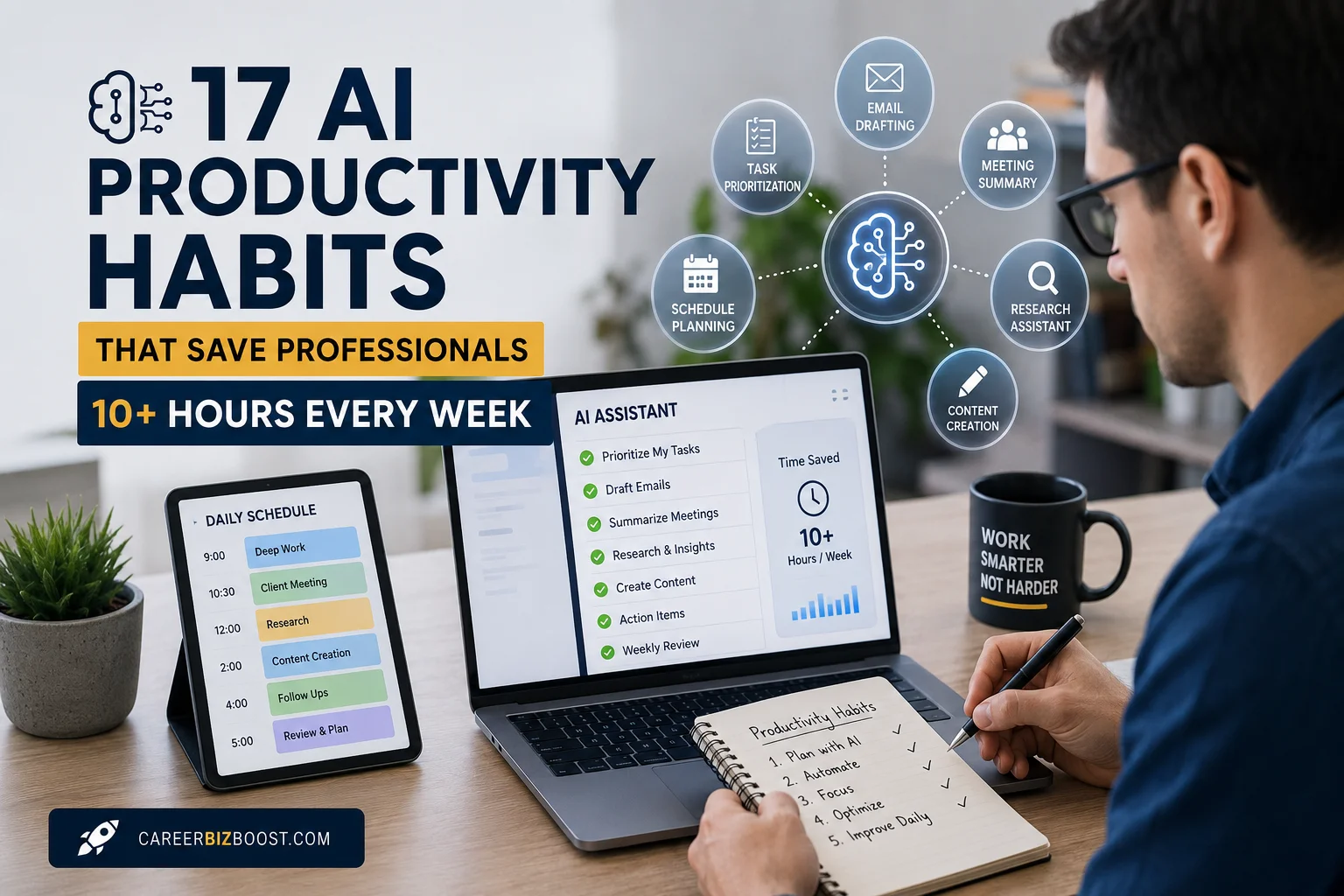
17 AI Productivity Habits That Save Professionals 10+ Hours Every Week
This post may contain affiliate links. At no extra cost to you, I may earn a small commission if you make a purchase. Read full disclosure »
Most professionals are not overwhelmed because they lack skill.
They are overwhelmed because they are buried under repetitive work.
Emails.
Meetings.
Scheduling.
Research.
Content drafting.
Task switching.
Documentation.
Reporting.
The modern workplace rewards speed, responsiveness, and output. But human energy has limits.
That is exactly why AI productivity habits are becoming essential for professionals who want to stay competitive without burning out.
The difference between people who constantly feel behind and people who seem to move faster is no longer just talent or discipline.
It is workflow design.
Professionals who build effective AI productivity habits into their daily routines are reclaiming hours every single week. They are automating low-value tasks, reducing decision fatigue, improving focus, and creating more time for strategic thinking.
And the best part?
Most of these habits require simple systems — not advanced technical expertise.
In this guide, you’ll discover 17 practical AI productivity habits that can realistically save professionals 10+ hours every week while improving output quality and reducing stress.
If you’re just getting started, learning how to use AI for productivity can help you automate repetitive tasks, streamline your workflow, and make each of these productivity habits even more effective.
Why AI Productivity Habits Matter More Than Ever
Artificial intelligence is no longer a futuristic concept reserved for tech companies.
It is now part of everyday work.
Writers use AI to brainstorm.
Managers use AI for summaries.
Marketers use AI for campaign planning.
Recruiters use AI for resume screening.
Freelancers use AI to automate client communication.
Executives use AI to accelerate research and decision-making.
The professionals gaining the biggest advantage are not necessarily the ones using the most tools.
They are the ones building repeatable AI productivity habits into their routines.
A single AI shortcut may save 5 minutes.
But a habit repeated daily creates exponential gains.
Saving:
- 15 minutes daily = 91+ hours yearly
- 30 minutes daily = 182+ hours yearly
- 1 hour daily = 365+ hours yearly
That is why AI productivity habits are rapidly becoming one of the most valuable professional skills in modern work environments.
Professionals who combine technical adaptability with strong AI-proof skills will remain valuable even as automation reshapes modern workplaces.
1. Start Every Morning With an AI Prioritization Session
Many professionals waste the first hour of the day deciding what to do.
That hidden decision fatigue drains productivity before real work even begins.
One of the most effective AI productivity habits is using AI to create a daily action roadmap.
Every morning:
- Paste your tasks into an AI assistant
- Ask it to prioritize based on urgency and impact
- Request a realistic schedule
- Identify distractions or low-value tasks
Example prompt:
“Here are my tasks for today. Prioritize them based on business impact, urgency, and energy requirements. Create a focused schedule.”
This reduces:
- Mental overload
- Task switching
- Reactive work patterns
Estimated time saved weekly:
2–3 hours
2. Use AI to Draft Emails Instead of Writing From Scratch
Email consumes massive amounts of professional time.
Most people rewrite the same communication patterns repeatedly.
One of the smartest AI productivity habits is turning AI into your communication assistant.
Use AI to:
- Draft professional responses
- Rewrite difficult emails diplomatically
- Summarize long threads
- Create follow-up messages
- Generate meeting recaps
Instead of spending 20 minutes drafting an email, professionals can reduce it to 3–5 minutes.
The key is customization.
AI should enhance your communication style — not replace your personality.
Estimated time saved weekly:
3–5 hours
3. Build an AI-Powered Meeting Workflow
Meetings often create a second layer of work:
- Notes
- Summaries
- Action items
- Follow-ups
One of the highest-impact AI productivity habits is automating post-meeting administration.
AI tools can:
- Transcribe meetings
- Extract action items
- Summarize decisions
- Organize tasks automatically
- Generate client follow-up emails
This eliminates manual note-taking and improves meeting focus.
Professionals can become more present instead of multitasking during conversations.
Estimated time saved weekly:
2–4 hours
4. Use AI to Eliminate Repetitive Research
Research can become an invisible productivity killer.
Professionals often spend hours:
- Searching articles
- Comparing sources
- Extracting information
- Organizing insights
Strong AI productivity habits simplify this process dramatically.
AI can help:
- Summarize research papers
- Compare competitors
- Analyze trends
- Extract key insights
- Build quick briefs
Instead of manually reviewing dozens of pages, professionals can accelerate learning significantly.
This is especially useful for:
- Content creators
- Consultants
- Analysts
- Project managers
- Entrepreneurs
Estimated time saved weekly:
2–6 hours
5. Create Reusable AI Prompt Templates
One major mistake professionals make is recreating prompts every time.
High performers build systems.
One of the smartest AI productivity habits is creating a personal prompt library.
Save prompts for:
- Email writing
- Brainstorming
- Content outlines
- Data summaries
- Client communication
- Social media posts
- Strategic planning
Over time, your AI workflow becomes faster and more accurate.
Professionals who master prompt systems dramatically reduce cognitive effort.
Estimated time saved weekly:
1–2 hours
6. Use AI to Break Large Projects Into Action Plans
Big projects create procrastination because they feel mentally overwhelming.
AI can act like a project decomposition engine.
One of the most practical AI productivity habits is using AI to convert complexity into actionable steps.
Example prompt:
“Break this project into milestones, weekly tasks, and daily execution steps.”
This improves:
- Clarity
- Momentum
- Execution speed
- Accountability
Large goals become manageable.
Estimated time saved weekly:
1–3 hours
7. Automate Content Repurposing
Professionals creating content often waste time rewriting the same ideas for multiple platforms.
AI productivity habits can transform one piece of content into many formats instantly.
Example:
- Blog post → LinkedIn post
- Webinar → Newsletter
- Podcast → Twitter thread
- Video → Email campaign
Repurposing increases reach without multiplying workload.
This is especially valuable for:
- Coaches
- Freelancers
- Agencies
- Personal brands
- Business owners
Estimated time saved weekly:
3–5 hours
8. Use AI to Create First Drafts Faster
Perfectionism slows productivity.
Blank pages slow productivity even more.
One of the best AI productivity habits is using AI for rapid first drafts.
Whether you are:
- Writing proposals
- Creating reports
- Building presentations
- Drafting articles
- Creating SOPs
AI can accelerate the starting phase dramatically.
The goal is not perfect output.
The goal is momentum.
Editing is easier than starting from zero.
Estimated time saved weekly:
2–4 hours
9. Build an AI-Based Knowledge Management System
Professionals lose enormous time searching for information they already encountered before.
AI productivity habits should include knowledge organization.
Use AI tools to:
- Summarize notes
- Organize ideas
- Categorize documents
- Build searchable databases
- Create quick reference systems
This reduces repeated learning cycles.
Information becomes accessible instantly.
Estimated time saved weekly:
1–2 hours
10. Use AI to Handle Low-Value Administrative Tasks
Administrative work silently consumes productive energy.
One of the most powerful AI productivity habits is identifying tasks that do not require human creativity.
Examples:
- Data formatting
- Scheduling
- Calendar planning
- Invoice drafting
- Documentation
- Status updates
AI automation reduces operational friction significantly.
Professionals gain more time for:
- Strategy
- Creativity
- Decision-making
- Revenue-generating work
Estimated time saved weekly:
2–5 hours
Many modern AI-powered career tools now automate repetitive administrative work, allowing professionals to focus on strategy, creativity, and higher-value execution.
11. Use AI for Faster Decision-Making
Many professionals lose productivity due to overthinking.
AI can help structure decisions more efficiently.
Useful prompts include:
- “Analyze pros and cons.”
- “Compare these strategies.”
- “Identify hidden risks.”
- “Recommend the highest ROI option.”
AI productivity habits improve thinking speed by organizing information clearly.
The final decision remains human.
But analysis becomes faster.
Estimated time saved weekly:
1–3 hours
12. Create AI-Assisted Learning Routines
Professionals must constantly learn.
But traditional learning methods are slow.
AI productivity habits can accelerate skill acquisition.
Use AI to:
- Simplify complex topics
- Summarize books
- Explain concepts
- Create study plans
- Generate quizzes
- Build learning frameworks
This helps professionals stay competitive without consuming excessive time.
Estimated time saved weekly:
1–2 hours
Building productive AI habits should go hand in hand with learning how to upskill with AI so you can stay competitive as workplace technologies continue to evolve.
13. Use AI to Reduce Context Switching
Constant switching destroys focus.
One underrated AI productivity habit is consolidating workflows.
Instead of using separate systems for:
- Writing
- Brainstorming
- Summaries
- Research
- Planning
Use AI as a centralized productivity assistant.
Reduced switching improves:
- Deep work
- Mental clarity
- Execution speed
Estimated time saved weekly:
2–4 hours
14. Build an AI-Powered Weekly Review System
Most professionals operate reactively.
High performers review systems consistently.
One of the best AI productivity habits is conducting a weekly AI-assisted performance review.
Ask AI:
- What consumed most time?
- Which tasks created highest ROI?
- What should be delegated?
- What bottlenecks appeared?
- How can next week improve?
This builds continuous optimization.
Small improvements compound massively over time.
Estimated time saved weekly:
1–2 hours
15. Use AI to Improve Focus Sessions
AI can support concentration by helping professionals structure deep work periods.
Try:
- AI-generated focus plans
- Pomodoro schedules
- Task batching systems
- Distraction elimination checklists
One overlooked aspect of AI productivity habits is mental energy management.
Time management alone is not enough.
Energy management matters more.
Estimated time saved weekly:
1–3 hours
16. Create AI-Assisted SOPs for Repeated Work
Repeated tasks should never rely entirely on memory.
Professionals who document workflows scale faster.
One highly effective AI productivity habit is using AI to create SOPs (Standard Operating Procedures).
AI can:
- Organize workflows
- Clarify steps
- Simplify instructions
- Create templates
- Improve onboarding
This is especially useful for:
- Teams
- Agencies
- Freelancers
- Startups
- Remote businesses
Estimated time saved weekly:
2–4 hours
17. End Every Day With an AI Reflection Routine
Most professionals end the day mentally exhausted.
But high performers review before resetting.
One of the most transformative AI productivity habits is a daily reflection practice.
Ask AI:
- What went well today?
- What wasted time?
- What should improve tomorrow?
- What tasks can be automated?
- What deserves deeper focus?
This creates continuous professional growth.
Small daily adjustments produce massive long-term efficiency gains.
Estimated time saved weekly:
1–2 hours
Small improvements compound over time, which helps explain why the AI career gap continues to widen between professionals who use AI regularly and those who rarely engage with these tools.
The Real Secret Behind AI Productivity Habits
The biggest productivity breakthrough is not AI itself.
It is intentional workflow design.
AI simply amplifies systems.
Professionals who:
- Automate repetitive work
- Reduce friction
- Protect focus
- Build repeatable habits
will outperform those relying purely on effort.
The future of work is not about working harder.
It is about combining human judgment with intelligent automation.
That is why AI productivity habits are becoming essential for career growth, remote work success, freelancing, leadership, and business scalability.
Common Mistakes Professionals Make With AI
Many people use AI incorrectly.
They:
- Depend on AI blindly
- Use too many tools
- Automate poor systems
- Ignore quality control
- Replace thinking instead of enhancing thinking
Effective AI productivity habits require balance.
AI should:
- Accelerate work
- Reduce repetitive tasks
- Support decision-making
- Improve consistency
But critical thinking remains irreplaceable.
The goal is augmentation — not dependency.
How to Start Building AI Productivity Habits Today
You do not need:
- Complex automations
- Expensive software
- Technical expertise
Start small.
Choose one habit:
- AI email drafting
- Meeting summaries
- Task prioritization
- Research assistance
Master one workflow first.
Then expand gradually.
The professionals who win with AI are not necessarily the most technical.
They are the most consistent.
Building strong AI productivity habits is one of the smartest ways to future-proof your career in an increasingly automated and fast-changing economy.
Many professionals understand AI’s potential but still face challenges adapting to AI at work. Recognizing these obstacles can help you consistently apply productive AI habits in your daily routine.
Final Thoughts
Time is becoming the most valuable professional asset.
The ability to reclaim even 5–10 hours weekly can dramatically improve:
- Career growth
- Income opportunities
- Creativity
- Mental clarity
- Work-life balance
The professionals thriving in the AI era are not replacing themselves with technology.
They are removing unnecessary friction from their workflows.
That is the true power of AI productivity habits.
The earlier you build them, the bigger your long-term advantage becomes.