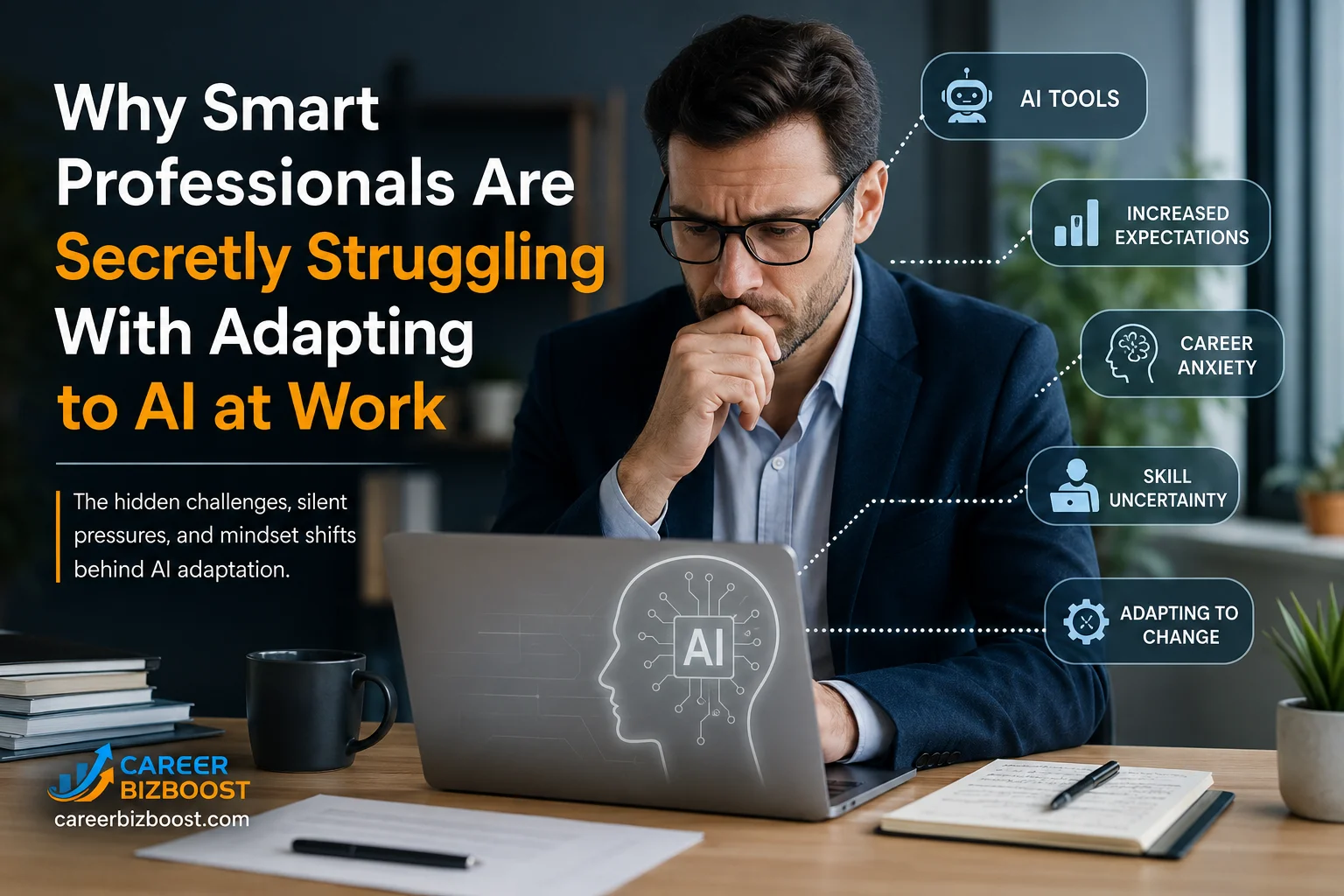
Why Smart Professionals Are Secretly Struggling With Adapting to AI at Work
This post may contain affiliate links. At no extra cost to you, I may earn a small commission if you make a purchase. Read full disclosure »
The biggest misconception about artificial intelligence in the workplace is that resistance only comes from outdated professionals.
That is not true.
Some of the smartest, most capable, and highly experienced professionals are quietly struggling with adapting to AI at work.
Not because they lack intelligence.
Not because they refuse to learn.
But because AI is changing something deeper than software.
It is changing how professionals define value, expertise, productivity, confidence, and even career identity.
And most people are not openly talking about it.
Behind polished LinkedIn posts and optimistic workplace conversations, many professionals are privately experiencing:
- anxiety,
- confusion,
- overwhelm,
- insecurity,
- skill uncertainty,
- and silent career pressure.
The emotional side of adapting to AI at work is rarely discussed honestly.
Yet millions of professionals are currently adapting to AI at work while trying to maintain confidence, productivity, and long-term career stability.
For many professionals, it is becoming one of the most emotionally complex career challenges of this decade.
The Hidden Emotional Cost of Adapting to AI at Work
Most discussions about AI focus on:
- productivity,
- automation,
- efficiency,
- innovation,
- and future opportunities.
Very few talk about the emotional friction professionals experience during adaptation.
For many people, work is deeply connected to identity.
A senior manager may take pride in strategic thinking.
A writer may value creativity.
A designer may value originality.
A recruiter may value intuition.
A consultant may value expertise built over decades.
Then suddenly, AI tools begin performing parts of those tasks in seconds.
Even highly competent professionals begin asking themselves difficult questions:
- “Will my skills still matter?”
- “Am I falling behind?”
- “What if younger professionals adapt faster?”
- “How much of my work can AI replace?”
- “Do I need to completely reinvent myself?”
This internal pressure is one of the biggest hidden realities of adapting to AI at work.
Many Professionals Feel Forced to Learn Publicly
One reason adapting to AI at work feels uncomfortable is because professionals are learning in public.
That creates vulnerability.
In earlier career stages, learning felt expected.
But experienced professionals often feel pressure to already “know.”
Now suddenly:
- executives are experimenting with prompts,
- managers are testing AI workflows,
- marketers are learning automation,
- writers are studying AI-assisted content,
- and entire teams are adapting in real time.
Many professionals secretly fear looking inexperienced.
Especially people who built careers around expertise.
This creates quiet stress inside organizations.
People attend AI webinars.
They save AI tutorials.
They experiment privately.
But many still feel uncertain internally.
One of the biggest barriers to AI adoption is not knowing how to use AI for productivity. Learning practical AI workflows can help you automate repetitive tasks, improve efficiency, and gain confidence using AI at work.
The Productivity Pressure Is Becoming Intense
One overlooked challenge in adapting to AI at work is the rising productivity expectation.
Once AI enters a workplace, expectations often shift immediately.
Managers start thinking:
- “This should take less time now.”
- “Can we reduce headcount?”
- “Why is output still slow?”
- “Can one person handle more?”
Professionals suddenly feel pressure to:
- produce faster,
- respond quicker,
- multitask more,
- and deliver higher volumes.
Ironically, AI tools designed to reduce stress sometimes create new forms of pressure.
Workers are not only adapting to technology.
They are adapting to accelerated expectations.
That mental load becomes exhausting over time.
For many employees, adapting to AI at work now feels tied directly to performance expectations, promotion opportunities, and future job security.
Many professionals are now exploring smarter workflows and AI productivity habits to manage rising workplace expectations without burning out.
Why Smart Professionals Often Overthink AI More Than Others?
Highly capable professionals sometimes struggle more because they think deeply about long-term consequences.
They see:
- industry disruption,
- workflow transformation,
- automation risks,
- competitive pressure,
- and changing hiring trends.
This awareness creates cognitive overload.
Instead of casually experimenting with AI, they may:
- analyze every risk,
- question every tool,
- compare every platform,
- and worry about future relevance.
Professionals with strong reputations often feel they have more to lose.
Especially mid-career professionals.
They are experienced enough to understand disruption — but established enough to fear displacement.
That tension makes adapting to AI at work emotionally complex.
Professionals who are deeply focused on adapting to AI at work often carry invisible mental pressure because they understand how quickly industries are evolving.
The Fear Is Rarely About Technology
Most professionals are not truly afraid of AI software.
They are afraid of what AI might change.
For example:
- career stability,
- income security,
- professional relevance,
- status,
- confidence,
- leadership value,
- and long-term employability.
A finance professional may not fear automation itself.
They may fear becoming less valuable.
A content writer may not fear AI-generated text.
They may fear becoming easier to replace.
A manager may not fear productivity tools.
They may fear reduced strategic importance.
Understanding this changes the conversation around adapting to AI at work.
The issue is not simply technical adaptation.
It is psychological adaptation.
Why Some Professionals Secretly Avoid AI Tools
Many professionals appear resistant to AI when they are actually overwhelmed.
There is a difference.
Some common hidden reasons include:
Fear of Looking Incompetent
People avoid tools they do not fully understand because they fear making mistakes publicly.
Information Overload
The AI space changes rapidly.
New tools appear constantly.
Many professionals feel exhausted trying to keep up.
Lack of Clear Guidance
Companies often demand AI adoption without providing structured training.
Employees are told:
- “Use AI.”
- “Improve efficiency.”
- “Automate workflows.”
But few receive clear implementation support.
In many workplaces, adapting to AI at work has become an unspoken expectation even when employees receive little structured support.
Perfectionism
Some professionals hesitate because they want to master tools immediately instead of learning gradually.
Fear of Dependency
Many workers worry about becoming too reliant on automation.
These concerns are more common than most organizations realize.
Adapting to AI at Work Requires Identity Shifts
This is the part few people discuss openly.
AI adaptation is not just about learning tools.
It often requires professionals to rethink where their value comes from.
For years, value may have been based on:
- information access,
- technical execution,
- research speed,
- writing ability,
- administrative efficiency,
- or repetitive expertise.
AI changes that equation.
The professionals thriving today are shifting toward:
- judgment,
- creativity,
- emotional intelligence,
- leadership,
- strategy,
- communication,
- and adaptability.
That transition can feel uncomfortable.
Especially for professionals who spent years mastering traditional workflows.
One reason adapting to AI at work feels emotionally difficult is because many professionals spent years mastering workflows that are now rapidly changing through automation and AI-assisted systems.
The professionals creating long-term stability are increasingly developing AI-proof skills like communication, strategic thinking, emotional intelligence, and leadership.
The Workplace Is Quietly Dividing Into Two Groups
Many organizations are now seeing a hidden divide.
Group 1: AI Experimenters
These professionals:
- test tools constantly,
- automate aggressively,
- adapt quickly,
- and embrace workflow changes.
Group 2: Silent Observers
These professionals:
- watch cautiously,
- hesitate privately,
- fear making mistakes,
- and delay adoption.
Interestingly, intelligence is not the deciding factor.
Confidence and experimentation matter more.
Professionals who treat AI as a learning process adapt faster than those waiting to feel fully prepared.
Why Mid-Career Professionals Feel the Most Pressure
Early-career workers often adapt quickly because experimentation feels natural.
Senior executives may delegate technical exploration.
But mid-career professionals often experience the greatest pressure.
They must:
- maintain performance,
- lead teams,
- stay relevant,
- learn new systems,
- compete with younger workers,
- and protect career stability simultaneously.
Many are balancing:
- family responsibilities,
- financial obligations,
- leadership expectations,
- and career uncertainty.
Mid-career professionals are often balancing leadership responsibilities while simultaneously adapting to AI at work faster than ever before.
This makes adapting to AI at work mentally exhausting for many experienced professionals.
What Smart Professionals Are Finally Realizing About Adapting to AI at Work
Many successful professionals eventually discover something important:
AI is not replacing professionals who think critically.
It is replacing repetitive workflows.
That realization changes everything.
The professionals gaining the greatest advantage are not necessarily technical experts.
They are professionals learning how to:
- collaborate with AI,
- accelerate execution,
- improve productivity,
- and focus on higher-value thinking.
AI works best as an amplifier.
Not a replacement for human judgment.
The Professionals Who Thrive Will Combine Human and AI Strengths
The future workplace will likely reward professionals who combine:
- human creativity,
- strategic thinking,
- emotional intelligence,
- communication,
- leadership,
- and AI-assisted productivity.
That combination is powerful.
AI can:
- speed up research,
- automate repetitive tasks,
- summarize information,
- organize workflows,
- and reduce operational friction.
But human strengths still matter enormously.
Especially:
- trust,
- empathy,
- negotiation,
- leadership,
- persuasion,
- critical thinking,
- and decision-making.
Professionals who integrate both sides effectively will remain highly valuable.
Professionals who continuously thrive AI skills and workflows are far more likely to future-proof their career against long-term workplace disruption.
Successfully adapting to AI requires continuous learning. Understanding how to upskill with AI can help you develop in-demand capabilities and stay competitive as workplace technologies continue to evolve.
Practical Ways to Start Adapting to AI at Work Without Feeling Overwhelmed
Many professionals fail because they try to master everything at once.
That approach creates burnout.
The key to successfully adapting to AI at work is building sustainable learning habits instead of trying to master every tool immediately.
Instead:
Start With One Workflow
Choose one repetitive task:
- emails,
- summaries,
- brainstorming,
- scheduling,
- note-taking,
- or research.
Then improve that single workflow.
Focus on Time Savings First
Do not chase every new AI tool.
Focus on reducing friction in daily work.
Building a clear AI career tools strategy can help professionals reduce overwhelm while learning automation gradually and intentionally.
Build Small Daily Habits
Consistency matters more than intensity.
Even 15 minutes daily creates momentum.
Learn Through Real Work
The fastest learning happens during actual professional tasks.
Accept Imperfect Learning
Nobody fully understands the AI landscape yet.
Even experts are adapting continuously.
That mindset reduces unnecessary pressure.
Successfully adapting to workplace AI is becoming a key factor in avoiding the growing AI career gap that is reshaping career opportunities across industries.
The Real Challenge of Adapting to AI at Work
The greatest challenge is not technological.
It is emotional flexibility.
Professionals must become comfortable:
- learning again,
- experimenting publicly,
- evolving continuously,
- and redefining professional value.
That process can feel uncomfortable.
But it is also where new opportunities emerge.
Organizations may continue changing rapidly, but professionals who approach adapting to AI at work with curiosity, flexibility, and strategic thinking will remain highly competitive in the years ahead.
The professionals who succeed will not necessarily be the most technical people.
They will be the most adaptable.
Final Thoughts
Many smart professionals are struggling silently with AI adaptation.
And honestly, that reaction is understandable.
Artificial intelligence is changing workflows, expectations, career paths, and professional identity at extraordinary speed.
But struggling initially does not mean falling behind permanently.
In many cases, thoughtful professionals simply need time to process change deeply before adapting effectively.
The key is avoiding paralysis.
Professionals do not need to master every AI tool overnight.
They simply need to begin.
Small experimentation today can create massive career advantages over the next several years.
The professionals willing to focus consistently on adapting to AI at work — without panic, denial, or blind dependence — will likely become the most valuable professionals in the modern workplace.