The AI Career Gap Is Growing Faster Than Most Professionals Realize—Are You Falling Behind?
This post may contain affiliate links. At no extra cost to you, I may earn a small commission if you make a purchase. Read full disclosure »
Something unusual is happening quietly inside modern workplaces.
Two professionals with similar experience, education, and intelligence can now produce dramatically different results.
Not because one works harder.
Not because one is more talented.
But because one understands how to create AI career success while the other is still treating artificial intelligence like a distant trend.
This gap is growing rapidly.
And most professionals still do not fully realize how deeply AI is beginning to reshape:
- productivity,
- visibility,
- hiring,
- promotions,
- influence,
- and long-term career growth.
The uncomfortable reality is that AI career success is slowly becoming a major competitive advantage in modern work environments.
And unlike traditional career advantages, this one compounds extremely fast.
Professionals who learn how to use AI strategically today may gain years of leverage over slower adopters.
That is why the emerging AI career gap matters far more than most people currently understand.
AI Career Success Is No Longer Limited to Tech Professionals
One of the biggest misconceptions about AI is that it mainly benefits engineers and developers.
That is no longer true.
Today, AI career success is becoming increasingly visible across:
- marketing,
- writing,
- sales,
- recruiting,
- consulting,
- project management,
- customer service,
- education,
- operations,
- and leadership roles.
The professionals advancing fastest are often not technical experts.
Many of these professionals are using practical AI-powered career tools to automate repetitive work, improve decision-making, and accelerate professional growth without needing advanced technical skills.
They are professionals who learned how to:
- reduce repetitive work,
- accelerate execution,
- improve communication,
- organize information faster,
- and increase output quality consistently.
In many industries, AI career success now comes from workflow intelligence rather than technical complexity.
That distinction matters enormously.
The Productivity Difference Is Becoming Impossible to Ignore
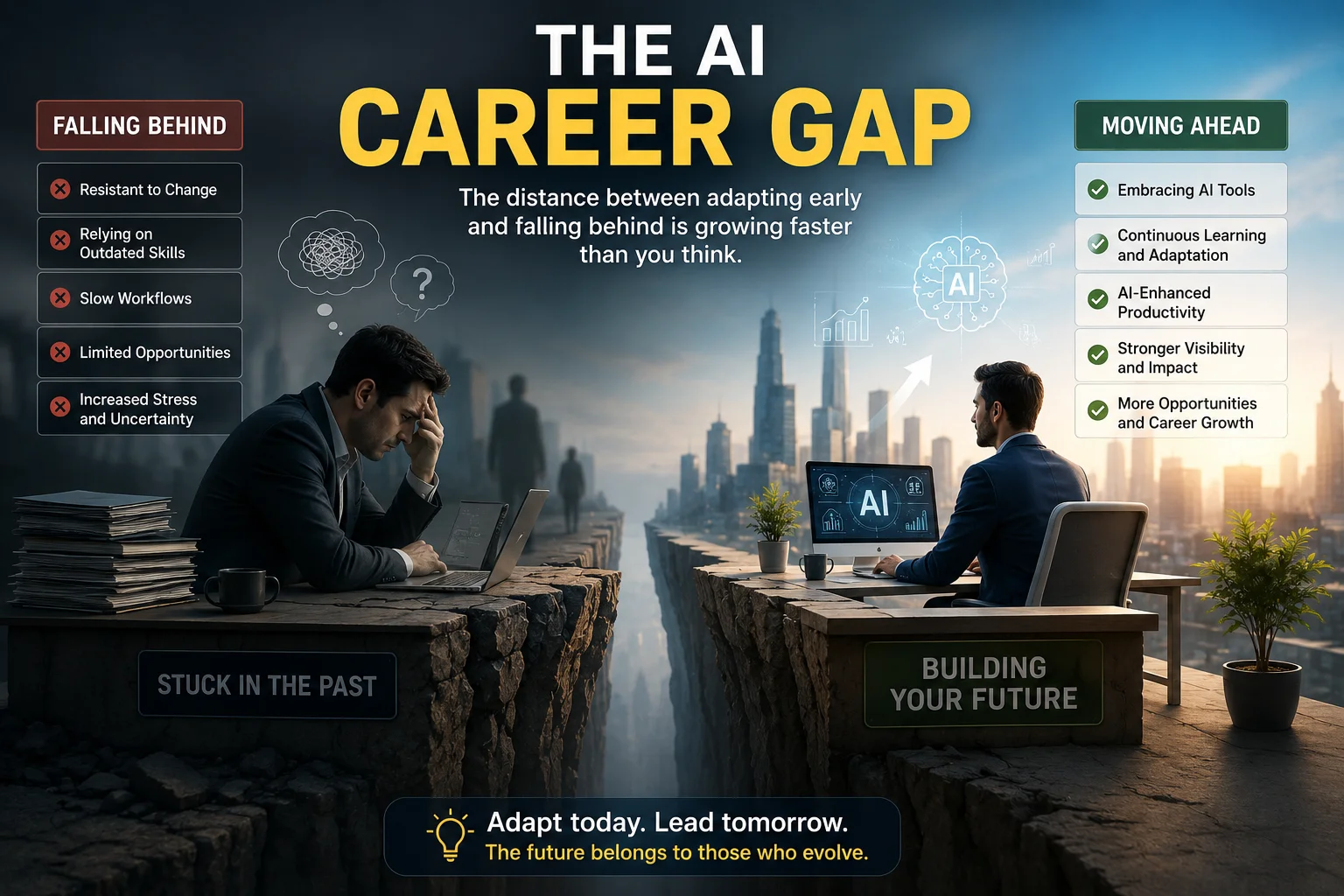
This is where the AI career gap becomes very real.
Professionals using AI strategically are often:
- responding faster,
- researching quicker,
- producing more content,
- organizing information better,
- and completing tasks in significantly less time.
Over weeks and months, those gains compound.
Learning how to use AI for productivity can help professionals eliminate low-value tasks, reduce mental overload, and focus more time on strategic work that creates career leverage.
A professional saving:
- 1 hour daily,
- improving communication quality,
- and reducing mental overload
can outperform peers consistently over time.
Managers notice this.
Clients notice this.
Teams notice this.
And eventually, hiring decisions begin reflecting this difference.
That is one reason AI career success is becoming increasingly tied to professional visibility and perceived value.
Many Professionals Still Underestimate the Speed of Workplace Change
One reason the AI career gap is widening is because many workers still view AI as optional.
They assume:
- adaptation can wait,
- industries will change slowly,
- or traditional experience alone will protect them.
But workplace transformation is already accelerating.
Organizations are beginning to expect:
- faster execution,
- higher productivity,
- improved efficiency,
- and stronger digital adaptability.
Professionals focused on AI career success are preparing early instead of reacting late.
One of the smartest ways to prepare is to learn how to upskill with AI, allowing you to build future-ready capabilities while workplace expectations continue evolving.
That creates a major long-term advantage.
Because adaptation becomes easier when approached gradually.
Professionals who delay adaptation often experience:
- overwhelm,
- confidence loss,
- productivity pressure,
- and professional insecurity later.
AI Career Success Is Quietly Influencing Hiring Decisions
Many hiring managers are no longer evaluating candidates only based on traditional qualifications.
Increasingly, they are paying attention to:
- adaptability,
- digital fluency,
- workflow efficiency,
- curiosity,
- and AI awareness.
This does not necessarily mean companies expect AI mastery.
But they increasingly value professionals who demonstrate:
- learning agility,
- openness to change,
- and productivity innovation.
For example, professionals showing AI career success often:
- improve turnaround times,
- streamline operations,
- communicate more efficiently,
- and handle larger workloads effectively.
Those outcomes influence career growth significantly.
Even when AI usage is not openly discussed during hiring conversations.
The Confidence Gap Is Becoming a Career Problem
One of the least discussed parts of AI career success is psychological confidence.
Professionals experimenting with AI consistently often develop:
- faster decision-making,
- stronger adaptability,
- greater workflow confidence,
- and reduced fear around change.
Meanwhile, professionals avoiding AI sometimes experience:
- uncertainty,
- hesitation,
- fear of irrelevance,
- and silent career anxiety.
This creates a dangerous cycle.
The more professionals avoid experimentation, the more intimidating adaptation becomes later.
And the more intimidating it feels, the longer they delay.
That emotional gap can eventually become a professional performance gap.
AI career success increasingly depends not only on technical ability — but also on emotional flexibility.
Professionals Winning With AI Think Differently About Learning
Traditional professional development often focused on:
- certifications,
- long courses,
- and structured training.
But AI career success is increasingly built through experimentation.
Successful professionals:
- test workflows,
- explore automation,
- refine prompts,
- optimize productivity systems,
- and learn through real work.
They do not wait to feel fully prepared.
Building consistent AI productivity habits helps transform occasional experimentation into sustainable professional advantages that compound over time.
They improve gradually through daily implementation.
This creates faster adaptation because learning becomes connected to actual professional needs.
The professionals advancing fastest are rarely the people consuming the most information.
They are usually the people applying knowledge consistently.
AI Career Success Is Creating Unequal Workplace Leverage
This is where the AI career gap becomes especially important.
Professionals who integrate AI effectively can often:
- handle larger workloads,
- improve strategic thinking time,
- automate repetitive tasks,
- and create higher-value output.
This creates leverage.
And leverage changes career trajectories.
For example:
- a consultant may manage more clients efficiently,
- a writer may produce stronger content faster,
- a recruiter may streamline communication,
- or a manager may reduce operational overload dramatically.
Over time, AI career success creates asymmetric professional growth.
Small workflow improvements eventually create massive competitive advantages.
The Biggest Winners Are Combining Human Strengths With AI Efficiency
The professionals thriving most are not replacing human skills.
They are strengthening them.
AI career success becomes much more powerful when professionals combine automation with:
- communication,
- leadership,
- creativity,
- empathy,
- strategic thinking,
- and relationship-building.
AI handles:
- repetitive execution,
- summarization,
- organization,
- and acceleration.
Humans still dominate:
- trust,
- persuasion,
- emotional intelligence,
- negotiation,
- and judgment.
The future workplace will likely reward professionals who integrate both effectively.
These uniquely human capabilities are among the most important AI-proof skills professionals can develop to remain valuable in an increasingly automated workplace.
Many Professionals Are Consuming AI Content Without Building AI Career Success
This is becoming surprisingly common.
People spend hours:
- watching AI videos,
- reading newsletters,
- following tool launches,
- and discussing future trends.
But very little changes in their actual workflows.
AI career success does not come from passive awareness.
It comes from practical implementation.
Professionals creating real career advantages are:
- reducing friction,
- improving execution,
- saving time,
- and strengthening productivity systems consistently.
Knowledge without implementation rarely creates meaningful professional leverage.
The AI Career Gap Will Likely Accelerate Over the Next Few Years
Right now, many workplaces are still in early adaptation stages.
But expectations are changing rapidly.
As AI tools improve:
- productivity benchmarks may rise,
- workflow standards may evolve,
- and adaptability may become increasingly valuable.
This means professionals building AI career success today may gain exponential advantages later.
Not because AI replaces everyone else immediately.
But because early adaptation compounds.
Professionals who learn gradually now will likely experience:
- less overwhelm,
- faster confidence growth,
- stronger career resilience,
- and better long-term positioning.
How Professionals Can Start Building AI Career Success Today
The good news is that professionals do not need:
- advanced technical expertise,
- expensive certifications,
- or complex automation systems.
The strongest AI career success strategies often begin very simply.
Start by improving one workflow:
- email writing,
- meeting summaries,
- brainstorming,
- scheduling,
- research,
- or planning.
Then build gradually.
Focus on:
- consistency,
- experimentation,
- and practical value.
Not perfection.
Professionals who adapt steadily usually outperform professionals who wait for complete certainty.
The Real Danger Is Not AI — It Is Delayed Adaptation
Many professionals fear AI itself.
Instead of resisting change, professionals should focus on adapting to AI at work so they can remain competitive, confident, and valuable as workplace expectations continue to evolve.
But the greater risk may actually be waiting too long to adapt.
Because workplace expectations are evolving regardless of personal comfort levels.
Professionals who avoid experimentation entirely may eventually face:
- confidence gaps,
- productivity disadvantages,
- and reduced professional flexibility.
Meanwhile, professionals focused on AI career success are quietly building:
- efficiency,
- adaptability,
- visibility,
- and long-term leverage.
That difference compounds over time.
And once large career gaps emerge, catching up becomes harder.
Final Thoughts
The AI career gap is growing faster than many professionals currently realize.
Not because AI instantly replaces workers.
But because professionals using AI strategically are beginning to accumulate small advantages repeatedly:
- faster execution,
- better organization,
- stronger productivity,
- improved visibility,
- and greater adaptability.
Over time, those small advantages become major professional differences.
That is why AI career success is increasingly becoming less about technology — and more about mindset, experimentation, and continuous adaptation.
The professionals who thrive in the coming years will likely not be the people who panic about AI.
They will be the people who learn how to work alongside it intelligently.